

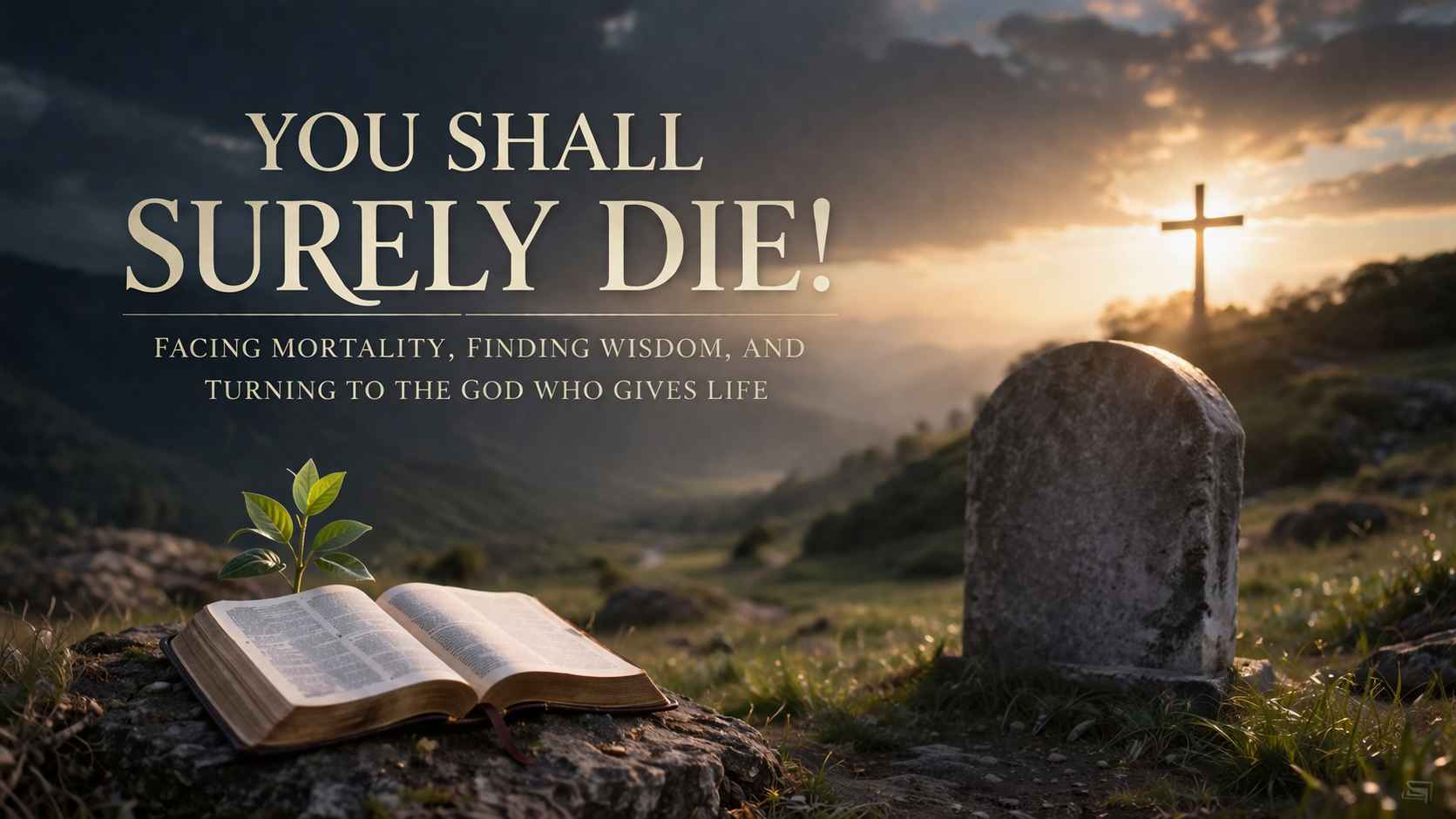
Why Genesis 5 teaches us to number our days—and run to Christ
Not long ago, someone in our wider Christian community became seriously ill and became convinced she might die within days. She spoke plainly with her family. She even began making burial arrangements. In God’s mercy, she recovered. But the moment exposed something many of us work very hard not to think about:
We live as though tomorrow is guaranteed—until suddenly it does not feel guaranteed at all.
Death has a way of shattering our illusions. A family loses a mother. A student buries an uncle. A friend receives a diagnosis. A phone call comes at an hour when phone calls rarely bring good news. In a moment, what felt distant becomes immediate.
Even then, many people still try to avoid the subject. Some call talk about death negative. Others treat it as though acknowledging mortality somehow betrays faith. But Scripture does not permit that kind of denial. Biblical faith is not pretending. It is not dressing avoidance in spiritual language. Biblical faith faces reality in the presence of God.
That is why Genesis 5 matters.
At first glance, Genesis 5 looks like one of those chapters people skim. It is a genealogy: names, years, sons and daughters. But if we listen carefully, it does not read like filler. It reads like a sermon. Again and again, the same words fall with dreadful regularity:
“And he died.”
The chapter is not trying to bore us. It is trying to wake us up.
Genesis 5 is the Bible’s refusal to let us live in fantasy
The opening chapters of Genesis begin in glory. Genesis 1 and 2 show us a world ordered by God’s goodness. Human beings are made in God’s image. Life with God in God’s world is the original design. We were not created for alienation, decay, or the grave.
But Genesis 3 changes everything.
When sin enters, death enters with it. God’s word to Adam is not poetic ornament. It is judicial sentence: “for you are dust, and to dust you shall return” (Gen. 3:19). Genesis 5 takes that sentence and writes it across the generations. What was spoken in Genesis 3 is now seen in Genesis 5. The curse is no abstraction. It reaches fathers and sons, generation after generation.
That is why the chapter feels so heavy. It is not merely telling us that people die. It is showing us that death reigns in Adam’s race.
The men in Genesis 5 live remarkably long lives by our standards. But even extraordinary longevity cannot overturn the verdict. Long life does not cancel death; it only delays it. Seth lived, and he died. Enosh lived, and he died. Kenan lived, and he died. Jared lived, and he died. Methuselah lived, and he died. Lamech lived, and he died.
The point is unmistakable: death is universal.
And Scripture presses deeper still. Death in Genesis is not presented as a harmless feature of creaturely existence, as though this is simply how things were always meant to be. It is the bitter fruit of sin. Adam’s descendants still bear God’s image, but they now belong to a fallen race under judgment. Mortality is not an innocent inconvenience. It is a sign that something has gone terribly wrong in the world.
Genesis 5, then, teaches us honesty. It teaches us that human beings are not permanent here. One day your life and mine will be spoken of in the past tense. One day our names will be attached to memories, photographs, and stories told by others.
That is not said to crush us. It is said to make us wise.
Wisdom begins when we stop pretending we are immortal
Psalm 90 gives language to the lesson Genesis 5 presses upon us: “Teach us to number our days that we may get a heart of wisdom” (Ps. 90:12).
Notice what Moses does not say. He does not pray, “Teach us how to avoid hard thoughts.” He does not ask God to help us feel endlessly secure in earthly life. He asks for wisdom, and wisdom begins with numbering our days.
That means Christians should not treat mortality as an embarrassing subject. We should pray for healing. We should ask God for mercy. We should cherish life as his gift. But none of that requires denial. In fact, denial does not make us more faithful. It makes us less so.
When we refuse to reckon with death, we tend to live foolishly. We postpone repentance. We assume we will have time later to deal with that secret sin, mend that broken relationship, make that needed confession, obey that clear command, or seek God with seriousness. We drift because we imagine there will always be another week, another year, another season.
But when God teaches us to number our days, we begin to see more clearly. We become less casual about sin and less intoxicated by trivial things. We learn to hold our plans more humbly. We become slower to nurse grudges and quicker to seek reconciliation. We grow more serious about prayer, more grateful for ordinary mercies, and more aware that our lives are not possessions we control, but gifts we will one day lay down.
This is not gloom. It is wisdom.
The person who numbers his days is not necessarily the most frightened person in the room. Often he is the freest. He knows this world, though good, is not ultimate. He knows he is not sovereign. He knows he cannot build a permanent home out of temporary things.
Genesis 5 is severe, but not hopeless
If Genesis 5 were the whole story, we would have realism but not rescue. The chapter tells the truth, but by itself it does not yet disclose the full cure.
Still, even within Genesis 5 there is a faint crack in the darkness. Enoch “walked with God, and he was not, for God took him” (Gen. 5:24). The rhythm is interrupted. The chapter is still dominated by death, but that small disruption hints that death will not write the final line forever.
That hint becomes a promise as the Bible unfolds.
The later genealogies of Scripture are not random lists. They trace the line of promise toward one person: Jesus Christ. He comes as the true man, the promised Son, the last Adam. He does not stand outside the human story lecturing us about death. He enters it. He takes on flesh. He bears our weakness. He lives under the shadow of the curse-burdened world we inhabit.
And then he does what no mere son of Adam could ever do.
He goes to the cross, not as a victim of blind fate, but as the sin-bearing Savior. He dies for sinners. He bears judgment. He enters the grave. But unlike the men of Genesis 5, his story does not end with “and he died.”
He died—and on the third day he rose again.
That is the center of Christian hope. Jesus did not merely survive death as an inspiring memory. He conquered it. He rose never to die again. In him, death has met its defeater.
So yes, Genesis 5 says to every one of us, You shall surely die. But the gospel says something even more decisive: if you belong to Christ, death will not have the last word over you.
For the Christian, death remains an enemy, but it is a defeated enemy. It is still painful, still unnatural, still bound up with grief. Jesus himself wept at a tomb. Christianity does not teach us to smile at death as though it were harmless. But neither does it leave us under death’s tyranny. Christ has passed through death and come out the other side in resurrection life, and all who trust him are joined to that victory.
What should this change in us now?
The right response to mortality is not panic, and it is not self-salvation. It is sober faith.
First, we should stop using “faith” as a shield against reality. Naming death does not dishonor God. Refusing to acknowledge what God has plainly told us about this fallen world is not spiritual maturity. Wisdom begins with truth.
Second, we should ask an uncomfortable but merciful question: If I knew I would soon die, what would I do differently?
That question is not meant to create drama. It is meant to expose delay.
What sin have you been excusing because you assumed you would deal with it later? What obedience have you been postponing? What apology have you avoided? What forgiveness have you withheld? What compromise have you learned to tolerate?
To number our days is not merely to think somber thoughts. It is to let reality drive us toward repentance, honesty, and renewed seriousness before God.
Above all, it means we must settle the largest question of all: Do I belong to Jesus Christ?
That is where this article finally presses. Death is not only a biological event. Scripture tells us that after death comes judgment. The deepest human problem is not simply that life is short. It is that sinners must meet a holy God. And the only safe place to stand in that meeting is in Christ.
Not in good intentions.
Not in religious activity.
Not in vague spirituality.
Not in family background.
Not in borrowed language about grace.
Only in Christ.
So if you have been living at a distance from him, come honestly. Stop pretending. Confess your sin. Abandon every rival hope. Trust the crucified and risen Savior. The call is not, “Make yourself ready by your own strength.” The call is, “Come to the One who is ready to receive all who come to him by faith.”
A word for the grieving and afraid
This truth lands differently depending on where a reader stands. Some need to be awakened from complacency. Others are already carrying fresh sorrow.
If you are grieving, this is not written to scold you. Tears are not unbelief. Grief is what love looks like when death intrudes. The Lord is not ashamed of your weakness. Christ is not distant from the brokenhearted.
And if you are afraid, hear this gently: God tells us the truth about death not because he delights in terror, but because he delights in rescuing people from lies. He does not expose our fragility so that we will despair. He does so that we will seek wisdom, stop building our lives on illusions, and anchor our hope in his Son.
Genesis 5 is severe mercy. It wounds our denial so that grace may heal us more deeply.
The chapter says what we do not want to hear: You shall surely die. But in saying it, God is doing something kind. He is teaching us to number our days. He is loosening our grip on what cannot last. He is driving us toward the only refuge that can hold in life and in death.
And that refuge is Christ.
So face mortality honestly. Do not hide from it. Do not romanticize it either. Let it make you sober, humble, prayerful, and ready. Then lift your eyes to Jesus Christ, who entered death for sinners and rose in victory.
In Adam, the sentence stands.
In Christ, the future opens.
That is why the Christian can tell the truth about death without surrendering to despair.