

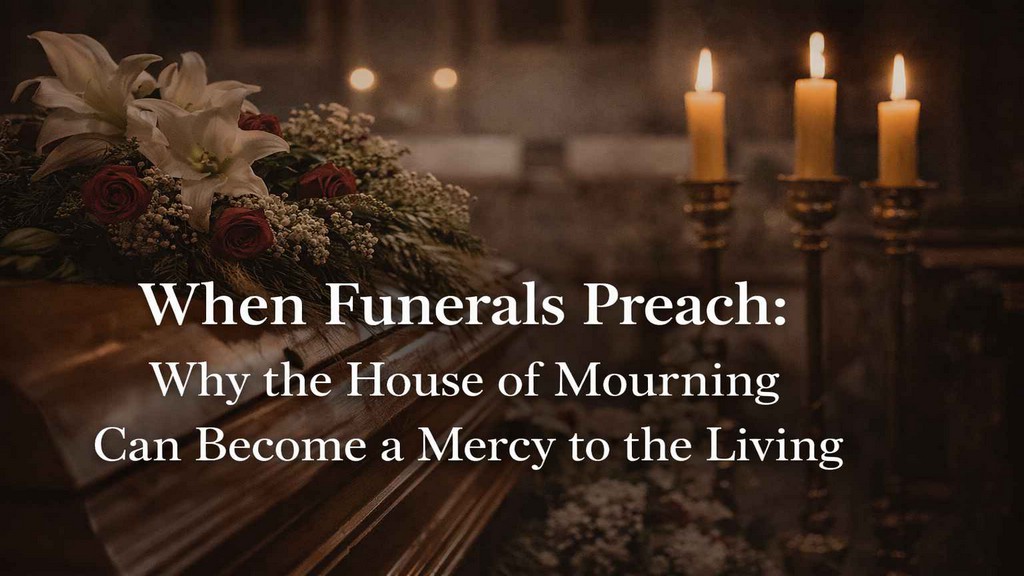
Some sermons do not need a microphone to be heard.
You walk into the house of mourning, and before anyone stands to speak, the message is already landing. The coffin is preaching. The grave is preaching. The tears are preaching. The question is not whether a funeral says anything. The question is whether we will listen.
That is why Ecclesiastes 7:2 sounds so surprising at first: “It is better to go to the house of mourning than to go to the house of feasting, for this is the end of all mankind, and the living will lay it to heart.” Those words feel almost upside down. We naturally prefer the house of feasting. We prefer weddings to burials, laughter to weeping, celebration to sorrow. Yet God says there is a kind of wisdom learned in the house of mourning that is rarely learned anywhere else.
This does not mean grief is pleasant, or that funerals are better because pain is somehow more spiritual than joy. It means mourning tells the truth in a way feasting often does not. The house of mourning strips away illusion. It confronts the living with reality. It presses on what we spend much of life trying not to think about: we are not permanent here.
The house of mourning is a classroom for the soul
Ecclesiastes says that in the house of mourning, “the living will lay it to heart.” That line matters. A funeral is not merely a cultural event. It is not merely a social obligation. It is not merely a place where a community shows love, though that matters deeply. A funeral is also a classroom for the soul.
There, God confronts us with truths we can easily ignore on ordinary days. The coffin says, without words, “This is the end of all mankind.” The grave says, “One day your body too will lie in the earth.” The tears say, “This world cannot keep safe everything your heart loves.”
That is why funerals can become a mercy. They force the living to stop drifting. They interrupt our busyness. They expose our smaller ambitions. They shake us awake to eternity.
Many people attend funerals without really listening. They arrive, sit, observe, speak, and leave. But Ecclesiastes tells us not to waste the sermon of the house of mourning. God means it to do something in us. He means it to humble us, sober us, and teach us wisdom.
Death is not merely an event. It is an appointment.
Ecclesiastes is sobering, but Hebrews 9:27 presses even deeper: “It is appointed for man to die once, and after that comes judgment.”
That word appointed matters. Death is not presented here as an accident of fate or an impersonal feature of the universe. It is an appointment fixed by God. We do not know the day. It is not written on our calendars. But it is not uncertain.
That truth exposes one of our deepest habits: postponement. We postpone repentance. We postpone obedience. We postpone serious dealing with God. We live as though life will always provide another week, another season, another convenient moment to settle the state of our souls.
But Hebrews does not let us live in that illusion. You may avoid the thought of death, but you cannot avoid the appointment.
And then comes the more solemn truth still: after death comes judgment.
That means the greatest question is not whether we have prepared for burial, but whether we are prepared to meet God. The house of mourning is spiritually valuable because it forces that question upon the living. What happens after death? Where will I stand before the Holy One? What confidence will I have when my life is laid open before the Judge of all the earth?
The Bible does not raise those questions to create theatrical fear. It raises them because they are true, and because truth is merciful. Better to be awakened now than to drift into eternity unprepared.
Our times are in God’s hands
If Ecclesiastes sobers us and Hebrews warns us, Psalm 31:15 steadies us: “My times are in your hand.”
This is one of the great sentences of biblical comfort. It means your life is not random. Your days are not finally governed by luck, panic, enemies, disease, superstition, or human control. God is not a spectator standing helplessly beside your life. He is Lord of providence. He governs the span and shape of our days.
That truth is both humbling and comforting.
It is humbling because it means we are not sovereign. We are not masters of our future. No amount of anxiety can give us control over the times God has not placed in our hands.
But it is also comforting because it means we do not live in a world of blind chaos. The believer can say, not lightly but truthfully, “My times are in your hand.” That does not make us reckless. Scripture never calls us to despise wisdom, reject medicine, or ignore responsibility. We are to live carefully, gratefully, and obediently.
Still, Psalm 31 frees us from another kind of bondage: fear-driven control. Some people live as though safety finally depends on them. So they try to manage every risk, master every variable, and secure themselves through endless anxiety. Others turn to rituals, charms, hidden practices, or mixed forms of trust, especially when death feels near. But if our times are in God’s hands, such false refuges cannot save us. They only reveal a heart that wants protection without surrender.
Psalm 31 gives us something better than panic and better than superstition. It gives us providence. We live wisely, but we do not live as slaves of fear. We take ordinary means seriously, but we do not treat them as saviors. We acknowledge that our times are held, not by our own strength, but by the hand of God.
Only Christ can carry us through death and judgment
At this point, the article must not stop with wisdom, warning, or providence. If it did, the reader would be left serious, but not safe.
So we must come to Christ.
Here is the glory of the gospel: Jesus Christ did not stand at a distance from the realities that frighten us most. He entered them. He took on flesh. He walked the road of weakness and sorrow in a fallen world. And he did not avoid death.
He entered it willingly.
He went to the cross not because death had ultimate power over him, but because he came to save sinners. He bore our sin. He bore our curse. He faced the judgment we deserve. He drank the cup we could never drink. And then, having truly died, he rose again in victory, never to die again.
That changes everything.
Hebrews says death is appointed, and after death comes judgment. The gospel says that for all who are united to Christ by faith, judgment has already fallen on another. It has not been ignored. It has not been postponed. It has been borne by the Son of God.
This is why the Christian can face death with sobriety and hope at the same time. Death remains an enemy. The Bible never asks us to pretend otherwise. Jesus himself wept at a tomb. The coffin is real. The grave is real. Sorrow is real. But for those who belong to Christ, death is no longer the doorway into condemnation. It is the passage into the presence of the Lord, and beyond it stands the promise of resurrection.
Funerals preach, then, not only because they tell us that we will die. They preach because they remind us that we need a Savior who can bring us through death and through judgment. And that Savior is Jesus Christ.
How should the living lay it to heart?
If the house of mourning is a classroom for the soul, what should the lesson produce in us?
First, do not waste the sermon of the funeral. The next time death comes near, do not rush past it as though it were just another event. Pause and ask, “Lord, what are you teaching me?” Let the truth land: this is the end of all mankind. One day I too will die.
Second, let death reorder your priorities. Some of the things we live for are too small to bear the weight of a human life. The house of mourning asks questions that the house of feasting often hides. What am I spending myself on? What have I been neglecting? What sins have I learned to excuse? What obedience have I postponed?
Third, prepare practically if needed, but do not confuse practical planning with spiritual readiness. There is wisdom in responsibility. There is nothing unspiritual about caring for your family or making sensible arrangements. But you can plan your burial and still be unprepared for eternity. Responsible planning is not a substitute for repentance and faith.
Fourth, reject fear-driven superstition and mixed trust. When death feels close, many people reach for false refuges. But the Christian must learn to say, with clean and undivided trust, “My times are in your hand.” Safety is not in objects, rituals, hidden consultations, or “covering all sides.” Safety is in the mercy of God given to us in Christ.
Fifth, and above all, come to Jesus Christ now. Do not postpone the state of your soul. Do not say, “Later.” Do not say, “I will first fix myself.” You cannot make yourself ready by self-improvement. The call of the gospel is not, “Make yourself acceptable.” It is, “Come to the Savior who receives sinners.” Confess your sin. Ask for mercy. Trust his finished work. Rest your whole hope on him.
A word for the grieving
This truth must be handled tenderly.
If you are grieving, this article is not telling you to stop crying. Scripture does not shame mourners for their tears. Jesus wept. Grief is not a denial of faith. It is love reacting honestly to loss in a broken world.
The Christian hope is not that death is unreal. It is that death is not final for those who are in Christ. The coffin is real, but it does not get the last word. The grave is real, but it is not ultimate. Christ has gone ahead of his people, and he will not lose one of those the Father has given him. On the last day, the same Lord who stood before Lazarus’s tomb will call his people forth.
So yes, we mourn. But we do not mourn as those who have no hope.
Listen to what funerals are saying
God says it is better to go to the house of mourning, not because sorrow is sweeter than joy, but because mourning tells the truth. It exposes illusion. It humbles pride. It interrupts sin. It reminds the living that life is brief, judgment is certain, and our times are in God’s hands.
And when those truths are received humbly, they become a mercy.
So listen to what funerals are saying. Let the coffin preach. Let the grave preach. Let the tears preach. But do not run to denial, empty slogans, fear, or superstition.
Run to Jesus Christ.
He is the one who entered death and broke its claim. He is the one who bore judgment for sinners. He is the one who holds the grieving, welcomes the repentant, and gives peace to those who trust in him.
The house of mourning can wake the living. But only Christ can make them ready.